Turn your issuer spreadsheet into a trusted list that verifiers read without asking you
The public sector already uses trusted lists to show who can be trusted in the EUDI Wallet ecosystem. The private sector will need the same. A trusted list is signed and machine-readable, and whoever wants to check one of your issuers reads it. Build your first test list with us in a demo of 20 to 30 minutes.
The test is free. Two or three issuer names are enough to start.
-
Signed
The list carries a digital signature. Whoever downloads it can verify who signed it and that nothing was changed.
-
Machine-readable
The list is published as XML and JSON in an eIDAS-compliant format and follows ETSI TS 119 602. Verifiers evaluate it automatically.
-
Maintained in one place
You add or remove a partner once. You can send onboarding requests to your partners and no longer reconcile lists with each of them.
Your spreadsheet is hard work. And only you can read it.
Most organisations struggle to maintain a list of trusted credential issuers in Excel or in their master data. You know who is on it and why. Everyone else has to ask you.
Each partner who wants to check an issuer sends a request, and someone on your team answers it by hand. When credentials arrive from a wallet, the verifier’s software needs that answer. It cannot read your spreadsheet.
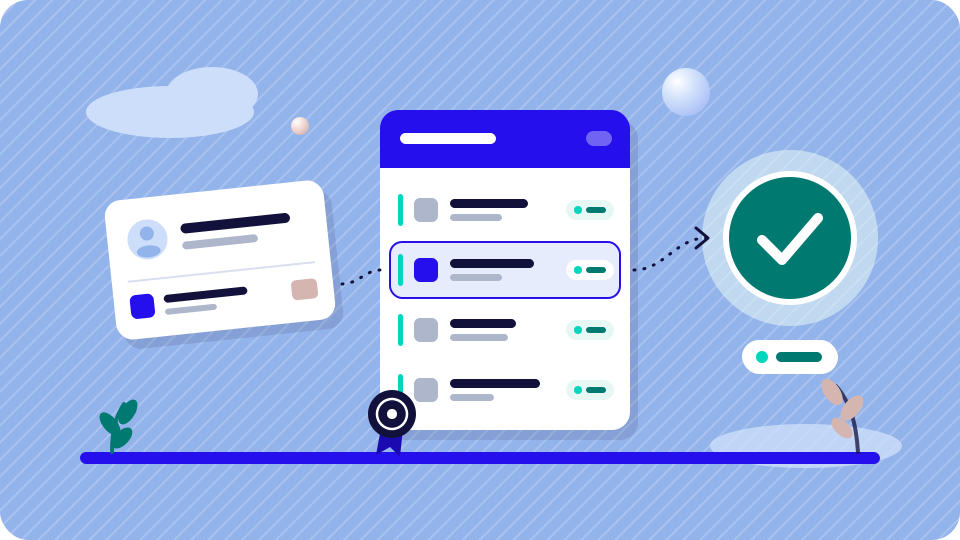
A cryptographically secured list that software can check
A trusted list names the organisations you recognise as trusted issuers, each with the role that authorises it to issue a credential. You publish it once, and every verifier can check it from the same source.
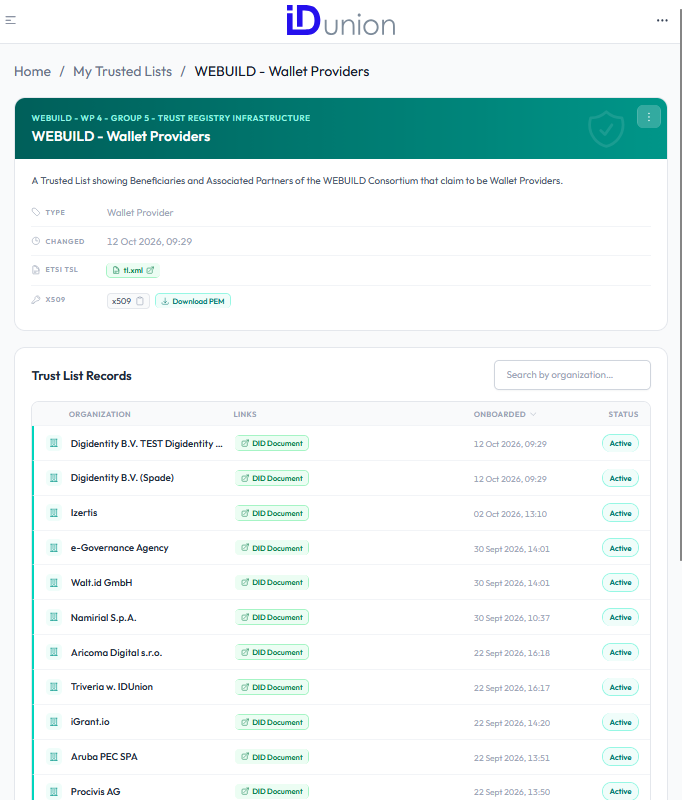
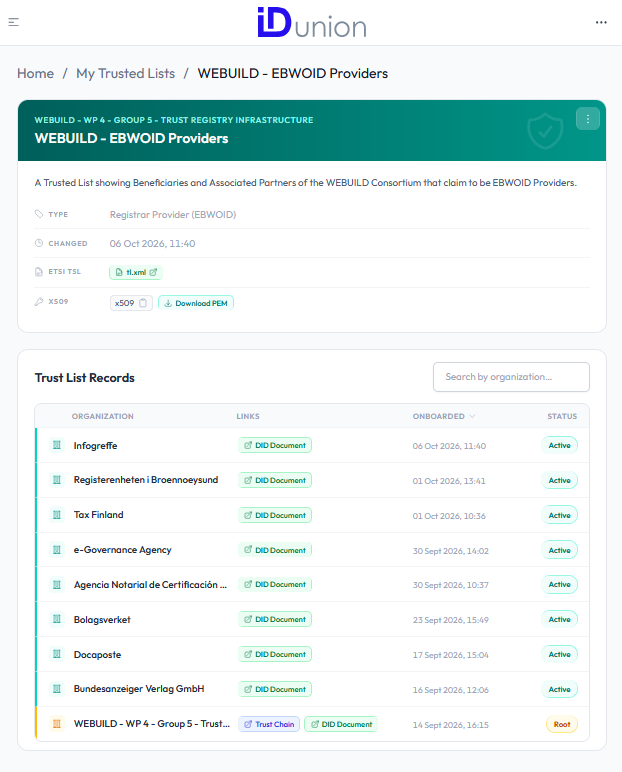
The Trusted List Portal
You manage your lists and your partners in the Trusted List Portal. The screenshots show public lists of the European consortium WE BUILD. IDunion provides the trust infrastructure for this consortium.
Three steps to your first trusted list
-
Book a demo
Pick a slot in our calendar. The demo takes 20 to 30 minutes, and a member of the IDunion team guides you through it.
-
Create your first list
You name two or three issuers from your current list and create the trusted list yourself. We guide you. Together we add a prepared demo partner and validate the finished list.
-
Bring in your own partners
After the demo, your test environment is activated. You invite your partners or add them. Each partner creates its own key and uploads only a certificate signing request.
What the test includes, and what it does not
Included
- Up to three trusted lists
- Hosting, free of charge
- Onboarding of your own partners
Not included
- A service level agreement
- Commercial use
- Use of test keys in production
Service levels and commercial use are available on request.
Your access is activated after the demo.
The German EUDI Wallet is scheduled for 2 January 2027
Electronic attestations of attributes (EAAs) have been tested in the German sandbox since April 2026. The other EU Member States have to introduce the wallet as well. According to the European Commission, Member States will make wallets available by the end of 2026.
Once the European Digital Identity Wallet is in use, verifiers will ask which issuers belong to your ecosystem. A test shows you now what it takes to answer that.
- EAA tests begin in the German sandbox
- Scheduled launch of the German EUDI Wallet
Run by a European cooperative with one vote per member
IDunion SCE is a European Cooperative Society, founded in 2022. It has ten members and works on a not-for-profit basis. Each member has one vote in our General Assembly.
IDunion is one of the 180 signatories of the Bitkom memorandum of understanding on the EUDI Wallet. In the European consortium WE BUILD, IDunion provides the trust infrastructure.
Our work has been part of three publicly funded programmes: Germany’s showcase programme “Secure Digital Identities”, the European Wallet Consortium and WE BUILD.
We process data in line with the GDPR.
Questions before you book
What is a trusted list?
A trusted list is a signed, machine-readable file. It names the organisations that an authority recognises. Software reads the list and checks whether an issuer is on it.
Is this the EU Trusted List?
No. The EU Trusted Lists are published by the Member States and name qualified trust service providers. Your list works on the same principle, but your organisation maintains it, not a Member State or the European Commission. It follows ETSI TS 119 602 and gives no one qualified status.
Who decides who is on the list?
You do. You add and remove the partners on your list. Partners can also start the onboarding themselves, and you approve them. IDunion provides the portal and hosts the list.
Who signs the list, and who holds the keys?
A trusted list is signed by its Trusted List owner. That is whoever creates the list. Each partner creates its own key during onboarding and uploads only a certificate signing request. The private key stays with the partner.
What do I need for the demo?
Two or three issuer names. Test names are enough, and you do not need a file or an export.
What does the test cost?
Nothing. The test is free, including hosting. It is limited to three lists, comes without a service level agreement and is not for commercial use. You can download your list at any time and host it yourself.
What happens after the test?
We will contact you to talk about what comes next.
What about OpenID Federation?
OpenID Federation is used to scale a trust ecosystem to many participants. If you plan to use it, talk to us. We help you implement it.
Build your first trusted list with us
Bring two or three issuer names. We bring the portal and a prepared demo partner.
Book a demoPrefer to write first? Send us an email at info@idunion.eu.